The Age of Mist
Before records
Heaven and earth were one, and spirits walked among the first mountains. When the Celestial Court was founded, it divided the realm into four lands and gave each an adept patron to watch over it.
“Where the mist keeps the old promises, and the heavens watch from far above.”
Yunshu is a realm of mist-wrapped mountains, terraced valleys and winding stone paths, where old shrines stand beside tea clans and every river has a story. Above the mortal realm sits the Celestial Court, which governs the adepti, spirit-beings who guard the land and are bound by the Court’s decrees. The mood is calm and scenic on the surface, with something ancient waiting underneath.
“The mountains remember what the people forget.”— Saying of the Miyun valley
Heaven and earth were one, and spirits walked among the first mountains. When the Celestial Court was founded, it divided the realm into four lands and gave each an adept patron to watch over it.
Humans built villages, trade routes and sects under the patrons’ eyes. Shrines rose on high places, and the adepti slowly became more distant from the people who prayed to them.
The patrons seldom appear, and the Court rules by decree rather than presence. Spirits and mortals share the land more closely than the Court would like, and its decrees have begun to reach down into mortal life.
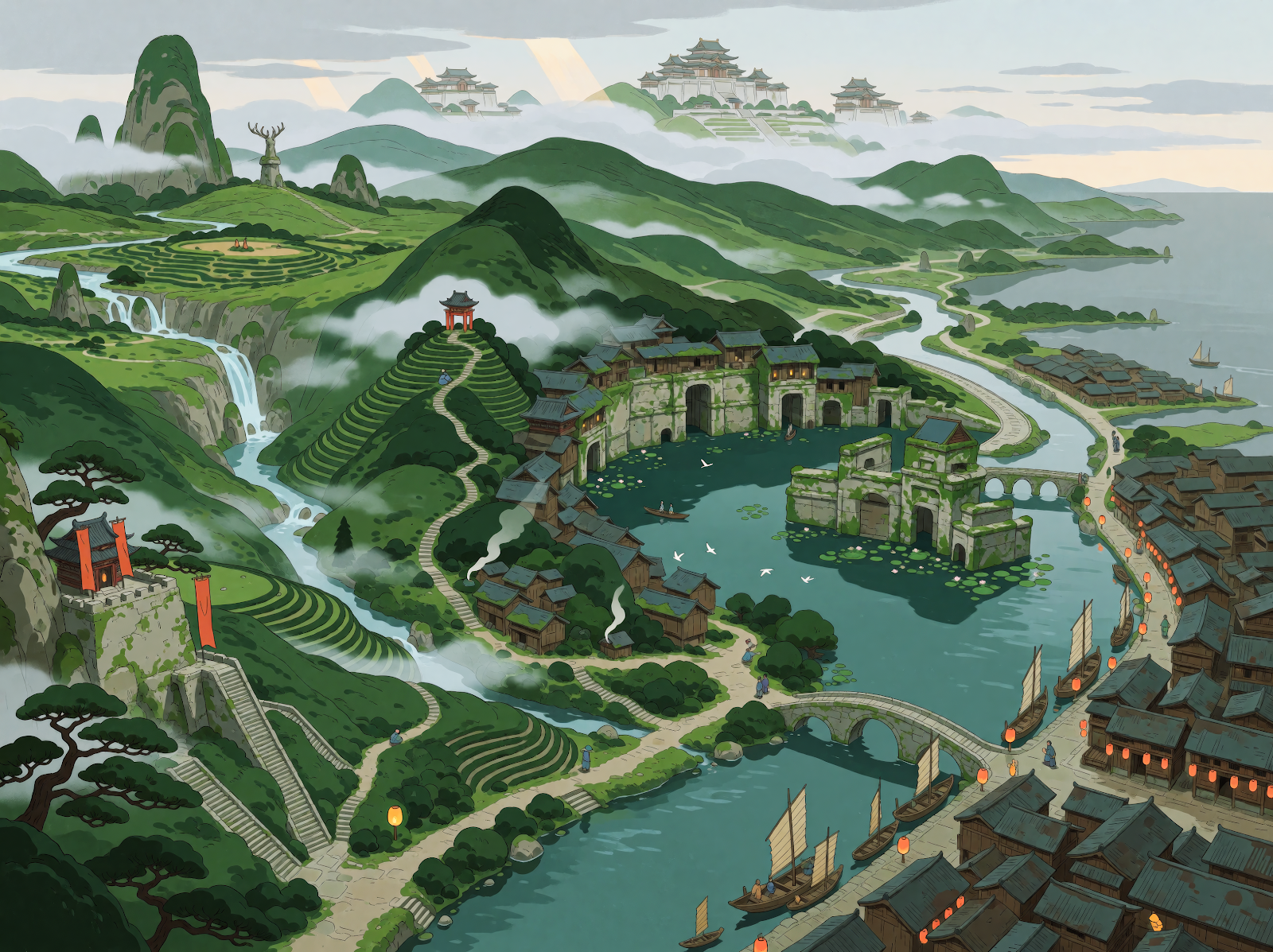
A deep valley of terraced tea gardens, pine slopes and old stone stairways that vanish into cloud. Villages cling to the hillsides, and almost every ridge has a small shrine. Travelers say the mist here listens.
The valley is ruled by a council of village elders and shrine keepers, who answer to its patron in name more than in practice. It is the quietest of the four lands and the one with the most buried secrets.
A land of rivers, canals and a harbor that never fully sleeps. Paper lanterns line every quay, and ships from distant shores trade silk, tea, salt and rumors. Nothing here is free, and nothing is lost that cannot be bought back.
Shuiyao is governed by the merchant clans, who sit in the Ledger Clan and follow the contracts of their patron. A written word is binding here, and breaking one is the worst offense.
Cold plateaus, jagged peaks and storm-cut ridges, home to the sword sects. Training grounds sit on every high ledge, and rivalries between schools are settled in formal duels more often than in war.
The Heights are ruled by a conclave of sect masters under the patron’s banner. Honor, discipline and lineage count for more than wealth, and a student’s master is spoken of as a second parent.
A province of flooded halls, sunken libraries and bridges over black water, built where an ancient city sank into a lake. Scholars here live among the ruins and copy its fading records by lamplight.
Moyuan is ruled by the Scribe Conclave, which decides what may be read and who may read it. Knowledge is currency and secrecy is a virtue, and outsiders are welcomed warmly but never fully trusted.
The most numerous people, found in every province. They tend the tea terraces, trade along the coast, train in the sects and copy the archives. They are short-lived beside the adepti, which is part of why the spirits find them so fascinating.
Spirit-beings who guard the land and serve the Celestial Court. Most take the shape of a beast, such as a fox, crane, tortoise, stag or owl, or wear a human form that keeps a few traces of it. Each is bound to a region and cannot easily leave it.
Their power comes from their authority, the right granted by the Court to command a part of the world. Without that authority, even an ancient adept is weak.
Demi-humans who carry the marks of an animal spirit, such as ears, tails or eyes, without being fully adepti. Some are descended from long-ago unions, others were simply born that way. Most live quietly among humans, and the Heights and the Vale are the places where they are most accepted.
Adepti stripped of their powers and authority by the Court and sent to the mortal realm. They keep their forms and their memories but little else, and they must live as mortals do. Their sentences carry conditions, and most of them are never spoken aloud.
There is no sorcery in Yunshu. Mortals rely on skill, craft and discipline, while adepti hold power through their authority, which is granted by the Celestial Court and can be taken away by it. This is the foundation of the Court’s rule.
An adept’s authority is the right to command part of the world, such as a river, a mountain, a season or a path. It is granted by the Celestial Court and can be revoked by it. While it lasts, an adept’s power is vast. Without it, they are barely stronger than a mortal.
The Court’s harshest punishment. An adept’s authority is sealed away, and they are cast down to the mortal realm. Every decree has terms for how the seal may be lifted, and these are set by the Court and left unspoken. Some terms are simple tasks. Others are not.
A fox adept of the Misted Vale is known to have been stripped of her powers and authority in this way.
The assembly of high adepti and heavenly officials who govern the spirit world. The Court grants authority to the adepti, keeps the balance between spirit and mortal, and passes judgment on those who break its laws. It rules by decree and is rarely seen. Its edicts are carried by silent messengers and signed in cloud-ink.
Its work is divided among four Halls: the Hall of Decrees for law and sentencing, the Hall of Seals for granting and revoking authority, the Hall of Records for the registry of spirits and mortals, and the Hall of Watching for oversight of the mortal realm. Mortals know them only by their visible works.
The Court does not speak to mortals, so mortals read it instead. A river that runs clear in a dry year, a flight of cranes at the wrong season, a bell that rings in an empty shrine: shrine keepers record such signs and decide what they mean, and villages act on what the keepers decide. Omens are taken seriously precisely because they cannot be checked. A false or misread omen can send a whole district chasing nothing, and to counterfeit one is counted among the gravest offenses against the Court.
Mortals give what they can spare: tea, rice cakes, lamp oil and incense at dawn. A written petition is never addressed to the Court itself but to the patron of the land, and the shrine keeper carries it to the shrine and leaves it there overnight. Silence is the usual answer and is not counted as a refusal. Most villagers believe that a petition which has been read and never answered has still been heard.
An edict arrives with a silent messenger and is signed in cloud-ink, a pale ink that dulls within days. Whoever receives one reads it aloud before witnesses while it is still bright. A copy kept longer than a few days is a copy made by a scribe, and the Scribe Conclave of Moyuan charges handsomely for such work. An edict is binding the moment it is read, whether or not anyone present understands it.
The Court is seldom loud in its anger. A district that has displeased it sees small things go wrong in a pattern: lamps that gutter in still air, a spring that runs low out of season, a festival rained out three years running. After that comes a silent Warden at the shrine gate. Mortals who see one close their doors, lower their voices and speak of other things, and no one repeats the terms of a sentence aloud.
For centuries Qingzhi held real authority over the mountain paths of Miyun Vale, and she watched over the valley as its villages grew. Today she keeps the valley shrine as a mortal, in the very place she once ruled from above. She looks to be in her mid-twenties and is in truth several centuries old. The valley still half-remembers her, and the seat of patron is still hers in title. The Hall of Seals holds her authority until the seal is lifted.
She was careless of her duties and kept meddling in mortal affairs, and then she pulled a prank that went further than she meant. A false omen of her making sent half the Court’s officials chasing nothing for a week. She insists nobody was really hurt. The Court answered with the Decree of Descent: her authority was sealed, her power stripped, and she was cast down to live as a mortal. She has been among mortals for only a few months, and she is still adjusting to hunger, cold and sleep.
Symbol: A white fox beneath a vermilion shrine gate. Festival: The Night of Lanterns, when the terraces are lit.
Bichen holds authority over the rivers and canals of Shuiyao Reach and has kept its accounts since the first harbor was dug. The merchant clans seal their contracts in the patron’s name, and no oath sworn in the Reach is thought to go unrecorded. The Ledger Clan files every contract in the Reach, but the clans say the patron’s own ledger is older, fuller and kinder to nobody.
Bichen is calm, exacting and in no hurry. Every agreement is weighed by its exact wording, and a broken oath is not punished at once but simply remembered. A debt is never forgiven, though it may be settled in ways the debtor did not expect. The Reach says that nothing is lost that cannot be bought back, and it is understood that Bichen sets the price.
Symbol: A tortoise carrying a scroll. Festival: The Day of Accounts, when old contracts are renewed.
Shiyan holds authority over the storm seasons of Kunlei Heights, and the sects say the thunder rolling along the ridges is the stag walking the cliffs. The Heights honor the patron above their own masters, though few have ever spoken with Shiyan and fewer have been answered. Hanfeng Citadel keeps an empty seat at the head of the conclave table, and no master has ever sat in it.
Shiyan is stern, honorable and slow to speak, and judges a disciple by what they do when no one is watching. A famous name, a high rank or a fine speech counts for nothing. The sects’ duels are theirs to settle, and Shiyan almost never steps in, but he remembers every vow broken on the Heights and is said to name them one by one when the storm season comes.
Symbol: A stag whose antlers are crossed blades. Festival: The Gathering of Swords, when the sects meet in friendly contest.
Yinshu holds authority over the night hours above the drowned halls of Moyuan, and is thought to read by the dark as others read by lamplight. The patron has not been heard to speak in living memory. The Scribe Conclave claims to interpret that silence, and its right to control the Archive rests on that claim more than on any decree. Whether Yinshu agrees, no one can say.
Yinshu is secretive and patient, and hoards knowledge as other patrons hoard gold. The patron never lies but seldom answers, and will trade a truth only for another of equal weight. It is said that Yinshu knows the true history of the realm, from the Age of Mist to the present day, and has shared it with no one. Some scribes whisper that the Archive is not the patron’s library at all, but a decoy.
Symbol: An owl with a closed book. Festival: The Night of Unread Pages, when the Sealed Gallery is honored.
Silent officials who carry the Court’s decrees into the mortal realm and watch for violations. They rarely speak, they never stay long, and they are almost never welcome.
An order of mortals, and sometimes the fallen, who tend the shrines, keep the old rites and pass messages between mortals and the adepti. Every province has them, and each shrine answers to its patron rather than to any ruler.
Sword schools and martial lineages from Kunlei Heights who travel the realm taking disciples, settling feuds and testing their skill. Some serve the patron, and others serve only their master.
The ruling body of Moyuan and the largest organization of scholars in Yunshu. It controls who may read the Archive, and its members trade favors in the form of knowledge.
Family-run estates and shops that grow, cure and sell the mountain teas. Their best leaves are said to carry a trace of the mist. The Clans are small and old, and they hold most of the valley’s quiet influence.
The merchant families of Shuiyao, who trade, lend and insure along every river and coast. Their contracts are sealed in the patron’s name, and they are among the few mortals who deal with the Court’s Hall of Records.
Messengers and guides who carry letters, parcels and travelers over mountain paths and canal roads. They carry a lantern by night and a bell by day, and all four provinces honor their safe passage.
The schools where the sects train disciples, take commissions as escorts and guards, and hold their formal duels. Admission is by recommendation and a trial, and a disciple’s rank within the Hall is displayed on a cord at the waist.
Gold buys little in the high passes, and a sealed note is worth nothing without a clan to honor it. In Yunshu, what a thing costs depends on who is selling it, who is watching, and what the buyer can be trusted to repay.
Copper cash, strung in cords of a hundred, is the everyday coin of every province, and one cord is about a laborer’s day. Silver is cast in boat-shaped ingots that carry the stamp of the clan that cast them, and it pays for ships, estates and sect fees. Gold is rare outside Shuiyao and is seen mostly as ornament.
The Ledger Clans issue paper notes sealed in Bichen’s name and redeemable at any Ledger Clan in the four provinces. A tea merchant can cross the Heights with a note and no coin, and even the sects, who distrust paper, accept them. A forged note is counted as a broken oath, and the Clans treat it as a matter for the patron rather than the magistrate.
| Province | Known For | Note |
|---|---|---|
| Miyun Vale | Tea, pine timber, dried herbs, terrace rice | Tea is the valley’s true wealth, and its leaf is graded by where and when it was picked. |
| Shuiyao Reach | Silk, salt, lanterns, shipping, loans, insurance | Ships bring goods from distant shores, and services are traded as freely as cargo. |
| Kunlei Heights | Iron, forged blades, wool, hides, escort work | The sects sell their swords as guards, and a commission is a kind of export. |
| Moyuan | Ink, paper, bound copies, reading rights | Knowledge is sold by the page and by the hour, and a favor in knowledge is as good as coin. |
No province can live on its own goods. The Vale has tea but little iron, the Heights have iron but little grain, the Reach has ships but no paper, and Moyuan has paper and almost no harbor.
Lamplight leaf is picked by lamplight on the Lantern Terraces at festival time and is never sold by weight. The Tea Clans give it as a gift and are remembered for it. Terrace tea is the fine leaf sold to the Reach and beyond. Hearth tea is the coarse everyday brew of the valley and the roads. The very best leaf is said to carry a trace of the mist, and every Tea Clan has its own story about why.
Reading rights are sold by the hour, and the price depends on what is read and who is asking. Scribes pay one another in copies, corrections and carefully chosen silence. A visitor with nothing to trade may offer a story, a map or a rumor, and the Conclave’s admissions clerks will weigh it as carefully as silver.
The Lantern Couriers’ safe passage is honored in all four provinces, and merchants pay a courier’s fee to travel under their bell and lantern. Each of the Nine Bridges of Shuiyao charges a toll to the benefit of the clan that owns it. In the Heights the sects hold the passes and sell escorts through them, and a traveler who refuses the escort is warned only once.
People whose names carry weight beyond their own towns. Qingzhi and the other three patrons are described under Court & Patrons.
Head of the oldest tea clan on the Lantern Terraces and the first to pick at the festival. She sits between the village council and the shrine keepers and is trusted by both, mostly because she has never been seen to prefer either. She refuses every offer the Ledger Clans make for her family’s finest leaf, and the Reach has stopped asking.
The eldest of the valley’s shrine keepers, who tends the small shrine where the mist is thickest and holds the valley’s longest record of omens. Wen Rui has seen two Wardens in a long life and speaks of neither. Young keepers come to learn how to read a sign, and leave having learned when not to.
Presiding master of the Ledger Clan in Jinbo Harbor for twenty-six years. He is said to hear a contract read once and repeat it word for word a year later, and no ruling of his has been overturned. He takes his evening meal at the same quay stall every night, and the Reach has learned that anyone he sits beside is someone he has decided to trust.
The senior sect master of Hanfeng Citadel and the voice of the Heights conclave. She has not drawn a blade in public for thirty years, and no one has dared to test why. It is said she has never broken a vow, and that this, rather than her sword, is the reason she is obeyed.
The Scribe Conclave’s clerk of admissions, who decides who may enter the Archive and for how long. Mo asks applicants what they would trade, never what they wish to read, and is said to know which answer is a lie. Mo has walked the full length of the Drowned Stacks and will not say what lies at the far end.
A courier whose bell has been heard on every pass in all four provinces. Lan is said to know three paths that appear on no courier’s map, and to have carried letters that nobody else would. Lan has never lost a parcel and has never explained how.
None of this is confirmed. Each tale is placed by who tells it, and the codex records it as it is told.
The Gallery has been closed for four hundred years. The Conclave says it is closed for the safety of the records. Older scribes say it was closed because of what was shelved there, and that someone wanted it unread.
No one in Moyuan will say the name of the city that sank beneath the lake, and it appears in no record the Conclave will show an outsider. Boatmen say the Ink Wells remember it even if the scribes do not.
Some months ago, shrine keepers across the valley recorded omens that contradicted one another for a full week, and Wardens were seen on the mountain paths in unusual numbers. The Court has given no account of it. A few villagers link it to the keeper of the valley shrine, who changes the subject whenever it is mentioned.
The merchant clans say that Bichen’s own ledger contains debts owed by adepti, and even by officials of the Court. They say this is why the Hall of Records treats the Ledger Clans so carefully.
The sects say every blade in the Hall of Broken Blades was broken in dishonor by its owner. Some older disciples will say, if pressed, that a few of them were broken by another’s hand, and that Shiyan knows whose.
In the Quiet Age the Court’s decrees have begun to reach into ordinary mortal life, and no one is sure why. Some say the Court is mending something it let slip during the Age of Mortals. Others say the Hall of Watching has lost sight of something, and the decrees are how it is looking.
Many adepti have been cast down, and keepers can recall very few who ever had their seal lifted. The Wardens say nothing either way. Some keepers believe the terms are rarely met. Others believe those who meet them simply leave the mortal realm and are never spoken of again.